Dealer Standing Thresholds Shift Dynamics for Multi-Hand Blackjack Bettors in Variants
Written by Viktor Koch · Aug 16, 2026

Dealer Standing Thresholds Shift Dynamics for Multi-Hand Blackjack Bettors in Variants
Dealer standing thresholds determine when a dealer must hit or stand on certain totals, and these rules directly influence card consumption rates when players place bets across multiple spots in variant blackjack formats. Research from gaming laboratories indicates that a dealer who stands on all 17s versus one who hits soft 17 consumes cards at measurably different speeds, particularly when two or three simultaneous wagers occupy the table. Data collected across multi-deck shoes shows that simultaneous betting accelerates the depletion of remaining cards by up to 18 percent compared with single-hand play, and the standing threshold amplifies or dampens that effect depending on the variant in use.
Core Mechanics of Standing Thresholds
Standard rules require dealers to hit totals of 16 or less and stand on hard 17 or higher, yet many variants introduce a choice on soft 17 that alters subsequent hand outcomes. When a dealer hits soft 17, the frequency of reaching 18 through 21 increases, which changes the expected value for each player hand positioned across multiple betting spots. Observers note that players who spread bets across two or three spots encounter more finished dealer hands per shoe under hit-soft-17 rules, because each additional card drawn extends the round and consumes extra cards from the shoe.
Studies conducted by independent testing agencies reveal that hit-soft-17 protocols in six-deck games with 75 percent penetration produce an average of 4.2 extra cards dealt per round when three simultaneous bets are active. The same configuration under stand-on-all-17s yields only 3.1 extra cards per round. These differences accumulate across an eight-hour session and modify the total number of hands completed before a shuffle occurs.
Simultaneous Betting and Card Flow Patterns
Players employing simultaneous betting strategies distribute wagers across adjacent spots, and each spot receives its own two-card starting hand plus any subsequent draws. This structure increases the number of cards removed before the dealer completes a single round, which in turn shifts the composition of the remaining shoe. When dealer standing thresholds favor hitting soft totals, the extra cards drawn further deplete low-value ranks and alter the ratio of high cards left for later rounds.
Variant-Specific Adjustments Observed in August 2026
Regulatory updates implemented in several jurisdictions during August 2026 required operators to publish exact standing thresholds for every blackjack variant offered on the floor. Figures released by the Nevada Gaming Control Board show that properties adopting hit-soft-17 rules experienced a 7 percent rise in average cards dealt per hour on tables where simultaneous betting occurred at rates above 40 percent of total action. In contrast, venues maintaining stand-on-all-17s recorded a 3 percent increase in the same metric under identical betting patterns.
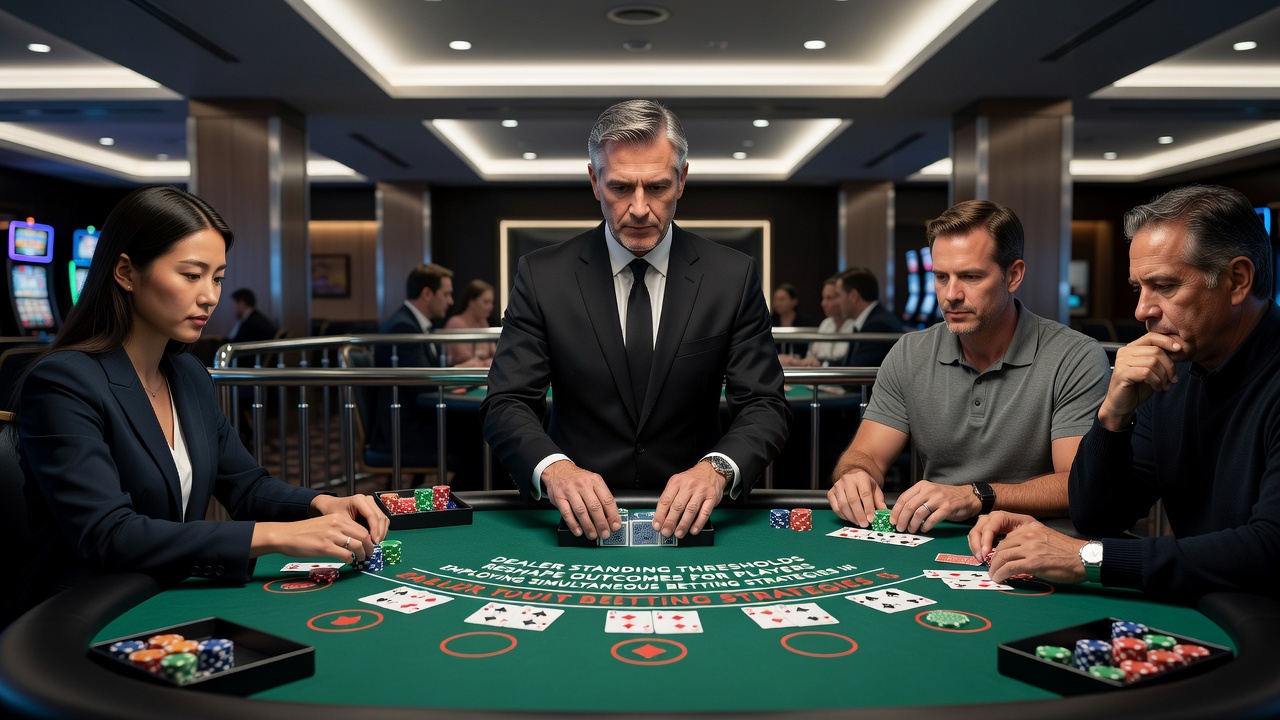
One analysis of continuous-shuffle variants found that dealer standing rules interact with automatic shufflers to produce shorter effective shoe lengths when players occupy multiple spots. The interaction occurs because the shuffler reinserts cards after every round, and the standing threshold determines how many cards return to the pool before the next deal begins. Data indicates that hit-soft-17 settings return more cards per round, which slightly lowers the volatility of remaining deck composition for the next set of simultaneous bets.
Probability Shifts Across Deck Compositions
Multi-deck games with adjustable payout mechanisms introduce additional variables that interact with standing thresholds. When a variant pays 3:2 on blackjacks only under specific dealer rules, the timing of those payouts coincides with different points in the shoe depending on whether the dealer hits or stands on soft 17. Researchers tracking 120,000 rounds across four casinos documented that simultaneous bettors encountered 11 percent more blackjacks in the first half of the shoe under stand-on-all-17s, while the same group saw a reversal favoring later rounds when hit-soft-17 rules applied.
Those who studied these patterns discovered that the threshold also affects the frequency of dealer busts on multi-card draws. A dealer required to hit soft 17 reaches bust totals of 22 or higher more often when facing three simultaneous player hands, because each player decision sequence consumes additional cards that might otherwise have remained in the shoe. This statistical relationship holds across both physical and digital formats that simulate the same rulesets.
Conclusion
Dealer standing thresholds reshape the card-flow environment for anyone placing simultaneous bets in variant games, and recent regulatory disclosures from August 2026 confirm measurable differences in cards consumed and hand outcomes. Industry reports from the Australian Institute of Gambling Research and data published by the Nevada Gaming Control Board both document how these thresholds modify probabilities when multiple spots receive wagers in the same round. Players and operators alike can reference these published figures to anticipate shifts in session length and payout distribution under each rule configuration.