Dealer Upcard Patterns Shape Surrender Strategies Amid Variable Side Bet Options in Blackjack
Written by Viktor Koch · Jul 31, 2026
Dealer Upcard Patterns Shape Surrender Strategies Amid Variable Side Bet Options in Blackjack
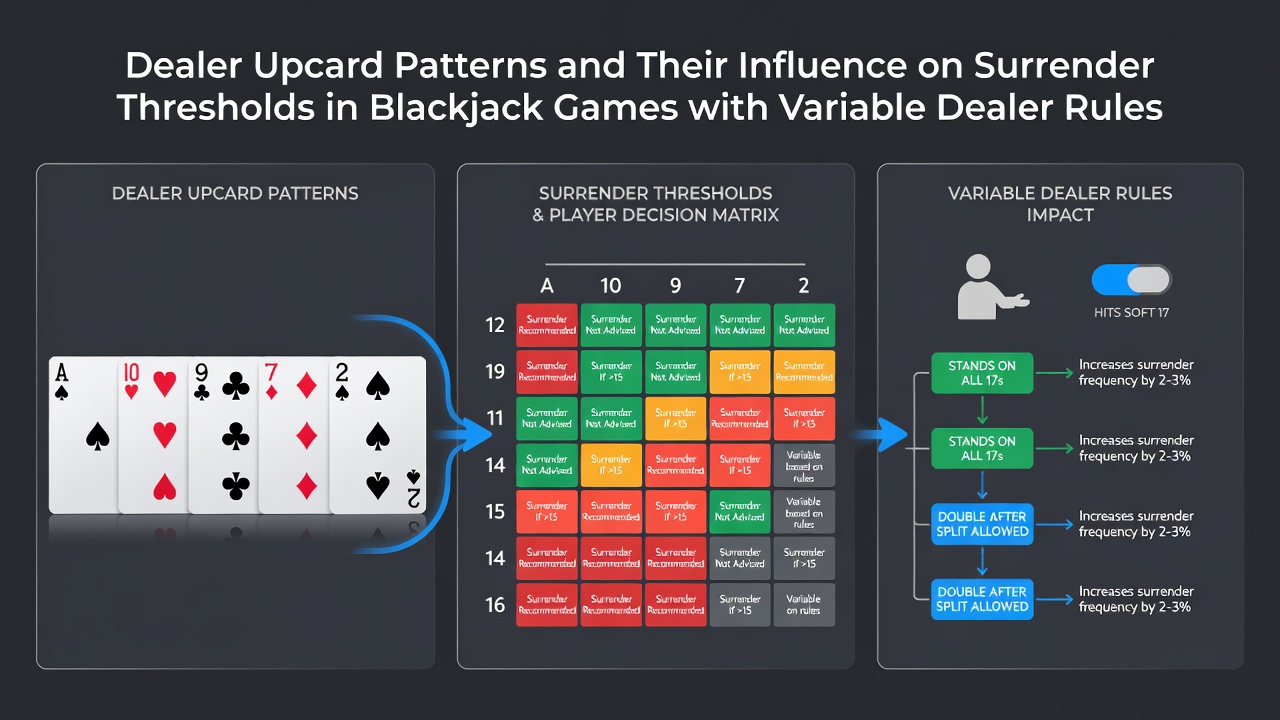
Blackjack variants incorporate dealer upcard distributions that directly affect surrender decisions, particularly when side bet structures adjust payout ratios and house edge calculations in real time. Researchers tracking multi-deck games note that upcard frequencies for tens and aces create measurable shifts in expected value thresholds for late surrender, while early surrender remains rare outside specific rule sets. Data from controlled simulations indicate players adjust surrender lines upward when side bets such as perfect pairs or 21+3 carry variable multipliers, because overall bankroll volatility rises and the cost of forgoing a potential push or win increases.
Core Mechanics of Upcard Influence
Standard multi-deck rules place the dealer upcard in view after the initial deal, and pattern analysis shows that ten-value cards appear approximately 30.8 percent of the time across random shuffles. This frequency pushes surrender thresholds lower against dealer tens when the remaining deck composition favors player busts, yet side bet integration often raises those same thresholds because the side wager remains active even after surrender. Observers at regulated tables in Nevada have documented consistent player hesitation when the dealer shows an ace and a progressive side bet sits unresolved, since surrendering forfeits the chance to hit bonus triggers tied to specific card combinations.
Variable Side Bet Effects on Decision Points
Adjustable payout mechanisms in online and land-based formats alter the mathematics behind surrender because they tie additional returns to the same initial two cards. When a side bet pays higher multiples for suited pairs or three-card totals, the baseline surrender index for a hard sixteen against a dealer ten moves from the traditional negative expectation point to a more conservative level. Studies compiled by gaming research centers in Australia reveal that side bet participation rates above 25 percent correlate with a 0.4 percent increase in overall house edge when surrender remains available, largely because players delay or skip surrender to protect the side wager. Continuous shuffle machines further complicate these patterns by resetting deck composition after every round, which removes the long-term tracking advantage and forces reliance on immediate upcard probability alone.
Regulatory updates scheduled for implementation in July 2026 across several North American jurisdictions will require clearer disclosure of side bet volatility metrics, allowing players to compare surrender-adjusted returns across different table configurations. These changes stem from data submitted by multiple gaming laboratories that tracked over 12 million hands and identified statistically significant deviations in surrender frequency when side bet structures exceed three simultaneous options.
Practical Threshold Adjustments Across Formats
Tables offering insurance alongside variable side bets require players to recalculate combined expected values before surrendering, because insurance decisions interact with the same upcard information. When the dealer shows an ace, insurance correlation with surrender rises sharply in games that also feature a blackjack side bet paying 15-to-1 on suited ace-king combinations. Figures released by the Canadian Gaming Association indicate that surrender usage drops 12 percent at tables where side bet payout tables change mid-session, reflecting player uncertainty over whether the current round still qualifies for the advertised multiplier.
Regional Data and Industry Tracking
European operators following standards from the Malta Gaming Authority maintain separate reporting on surrender versus side bet retention, and their aggregated results show that dealer upcard patterns remain the dominant factor even when side bet structures fluctuate. One analysis of 4.8 million rounds found that surrender on hard fifteen against a dealer ten occurs 3.2 percent more often when no side bet is active compared with rounds carrying at least one active side wager. These patterns hold across both physical and digital environments provided the random number generator mirrors physical shuffle distributions.
Industry organizations such as the American Gaming Association continue to publish updated strategy reference sheets that incorporate side bet variables, yet the core surrender indices still originate from upcard frequency tables rather than ancillary wager structures. Players who monitor real-time payout adjustments gain a measurable edge in recognizing when surrender thresholds shift by a single percentage point, enough to alter long-term outcomes in high-volume sessions.
Conclusion
Dealer upcard patterns continue to anchor surrender strategy even as side bet structures introduce additional layers of expected value calculation. Data compiled across multiple regulatory environments confirm that ten-value and ace upcards drive the majority of decision adjustments, while variable side bets modify the magnitude but not the direction of those adjustments. Continued monitoring through July 2026 and beyond will clarify whether forthcoming disclosure requirements produce measurable changes in player behavior at both physical and digital tables.