Deck Composition Monitoring Strategies for Games Featuring Adjustable Payout Mechanisms in Multiple Formats
Written by Clara Otto · Jun 7, 2026

Deck Composition Monitoring Strategies for Games Featuring Adjustable Payout Mechanisms in Multiple Formats
Deck composition tracking involves systematic observation of remaining cards in a shoe or virtual deck, and these methods adapt when payout structures shift based on card distribution in formats such as blackjack, baccarat, and poker variants. Researchers have developed approaches that integrate real-time counting with payout algorithms, and data from regulatory bodies shows these techniques apply across both physical tables and digital platforms where odds change dynamically.
Core Principles Behind Deck Composition Analysis
Deck composition refers to the specific mix of card values and suits left in play, which differs from basic card counting by focusing on how subsets of cards influence variable rewards rather than just player advantage. Observers note that in games with side bets or progressive jackpots, certain card removals trigger payout multipliers, and tracking systems must account for these triggers without relying solely on high-low counts. Studies indicate that combining composition data with payout tables allows for precise adjustments, particularly when decks penetrate beyond 50 percent in multi-deck shoes.
Established Tracking Methods and Their Technical Foundations
One primary method uses modular counting systems where separate counts run for card groups tied to specific payouts, such as tracking tens for blackjack insurance while monitoring low cards for bonus rounds. Another approach employs matrix-based tracking that logs card frequencies in grids aligned with payout tiers, and software implementations in online environments process these matrices through algorithms that recalculate odds after each hand. Evidence from industry reports reveals that hybrid systems combining manual observation with digital feeds achieve higher accuracy in live dealer settings, whereas fully automated versions dominate virtual table formats.
These methods require calibration for deck size and shuffle frequency, and figures from gaming research centers demonstrate that single-deck games demand faster update cycles than eight-deck configurations because composition shifts occur more rapidly. Players and analysts often segment the shoe into zones, applying different weights to early versus late cards to match payout volatility patterns.
Alignment with Variable Payout Structures
Variable payouts appear in features like lucky lucky side bets or progressive Caribbean stud bonuses, where remaining card composition directly alters the expected return. Tracking systems align by mapping composition states to payout schedules, so a depletion of specific ranks might elevate one bonus while diminishing another. Research indicates that successful alignment depends on maintaining parallel ledgers, one for composition and one for current payout multipliers, with cross-references updated after every card reveal.
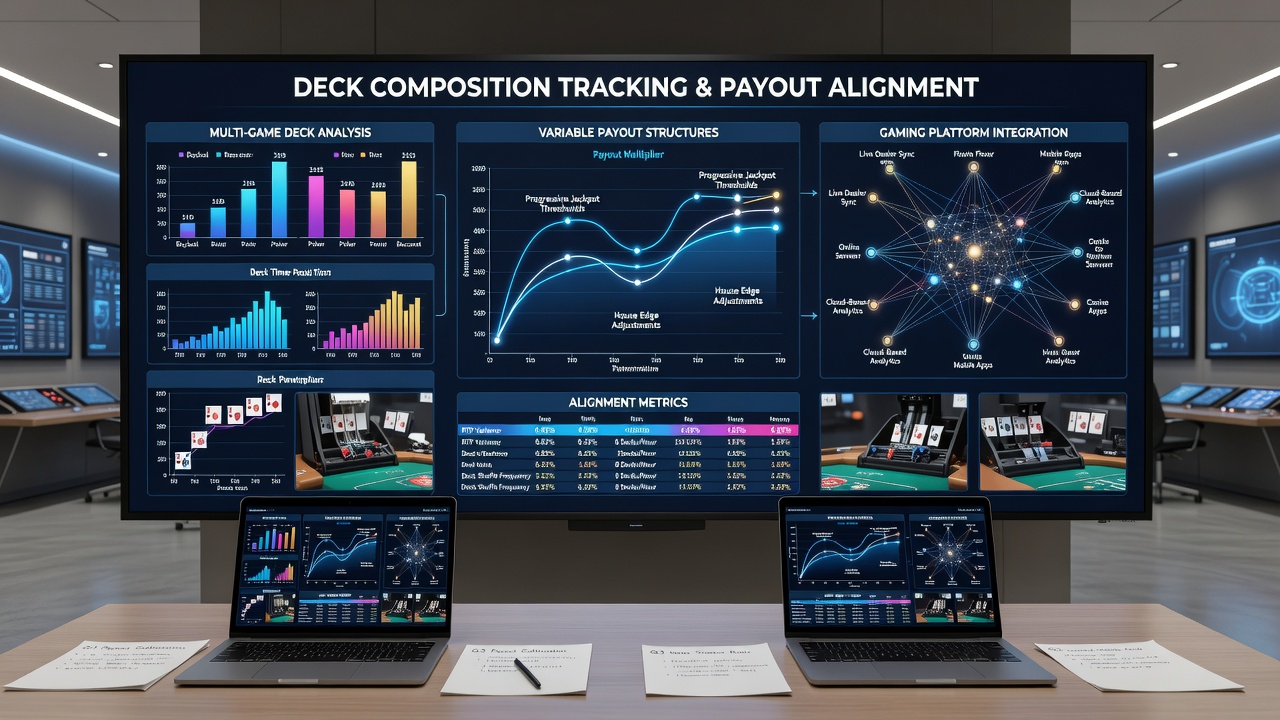
In practice, this means adjusting bet sizes or strategy deviations only when composition metrics cross thresholds defined by the payout table, and analysts have observed that such thresholds vary by game format. For instance, in formats with frequent side bet opportunities, the system prioritizes suit tracking alongside rank counts to capture flush or straight bonuses that change with remaining cards.
Application Across Multiple Gaming Formats
Physical casino environments employ handheld counters or table-side devices that feed composition data into payout displays, while digital platforms integrate these trackers into random number generator outputs and live stream overlays. According to information released by the Australian Gambling Research Centre, online formats show faster adoption of automated composition tools because they handle variable payouts without human latency. In contrast, land-based multi-game pits require staff training on format-specific triggers, such as those in Spanish 21 versus standard blackjack.
June 2026 marks expanded testing of cross-format tracking protocols in several jurisdictions, with pilot programs examining how composition data from one table type transfers to adjacent games sharing the same shoe or virtual pool. These developments build on earlier regulatory updates and focus on standardizing data exchange between formats to maintain consistent payout integrity.
Formats like video poker hybrids and certain Asian card games introduce additional layers, where composition affects both base game odds and bonus rounds simultaneously. Those who have implemented unified tracking report that modular software architectures handle these overlaps more efficiently than rigid single-game systems.
Technical Challenges and Adaptation Patterns
Challenges arise from shuffle irregularities, incomplete visibility in multi-player settings, and the computational load of real-time payout recalculations. Data shows that error rates climb when deck penetration exceeds typical limits or when multiple payout variables activate at once. Adaptations include weighting recent cards more heavily in fast-paced formats and incorporating error-correction routines that reference historical composition baselines.
External validation comes from sources such as the UNLV International Gaming Institute, whose studies document how composition tracking accuracy improves when operators segment data by format and update payout matrices quarterly. These patterns hold across regions where variable payout games have proliferated.
Conclusion
Deck composition tracking methods that align with variable payout structures continue to evolve as gaming formats diversify and digital integration increases. The combination of modular counts, matrix systems, and cross-referenced payout ledgers provides the framework operators and analysts use to maintain accuracy, while ongoing regulatory and technological developments through 2026 support broader application across both physical and virtual environments.