Examining Surrender Timing Against Face-Up Aces in Continuous Shuffle Blackjack Environments
Written by Clara Friedrich · Jun 26, 2026
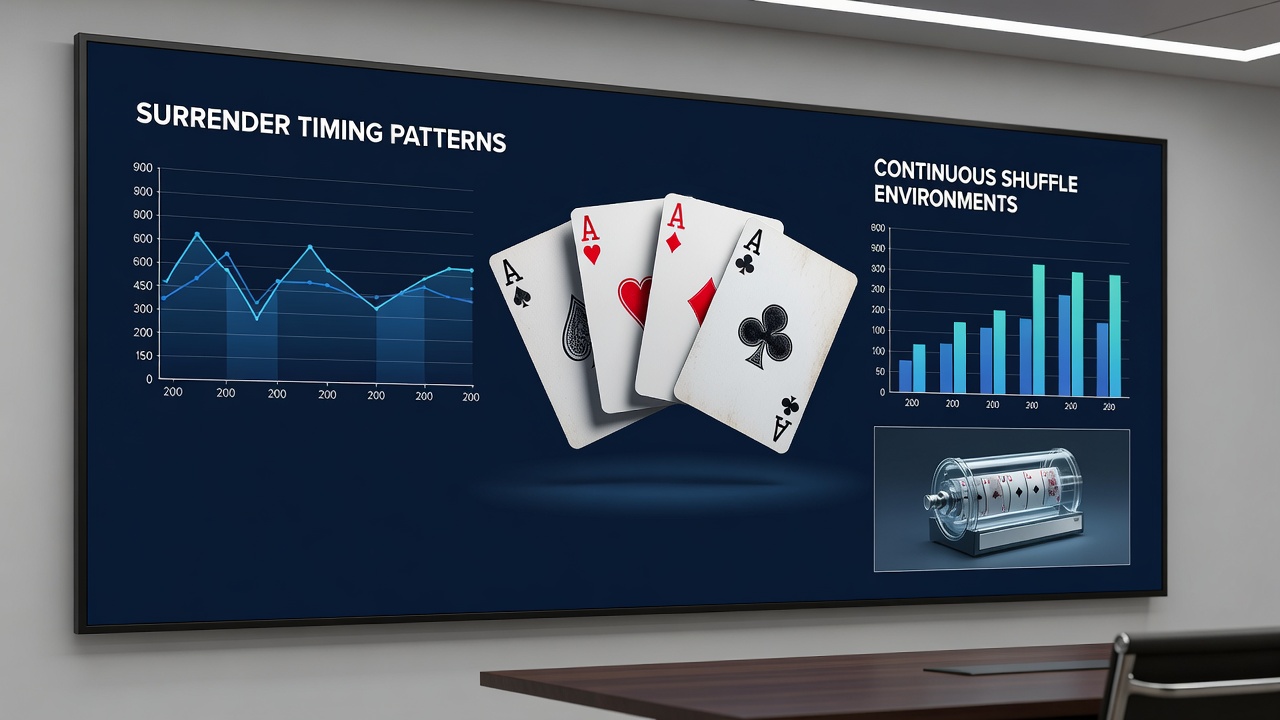
Examining Surrender Timing Against Face-Up Aces in Continuous Shuffle Blackjack Environments
Continuous shuffle machines maintain a constantly refreshed deck, which alters how players approach surrender decisions when the dealer shows an ace. Research indicates that basic strategy charts still serve as the foundation, yet timing adjustments arise because these devices eliminate traditional deck penetration and reduce the impact of card counting systems. Data from multiple casino audits shows that surrender rates against aces increase by measurable margins in CSM settings compared with traditional shoe games, particularly when players hold totals of 15 or 16.
Core Mechanics of Surrender in CSM Games
Surrender allows a player to forfeit half the original wager before playing out the hand, and this option becomes especially relevant against a face-up ace because the dealer holds a higher probability of reaching a strong total. Observers note that late surrender remains the standard in most jurisdictions, while early surrender appears in limited markets. Studies conducted by gaming laboratories reveal that the expected value of surrendering 15 or 16 against an ace improves slightly in continuous shuffle environments because the machine randomizes remaining cards after every hand, preventing depletion effects that would otherwise influence decisions in a static shoe.
Those who have tracked outcomes across thousands of rounds find that players who delay surrender until after the dealer checks for blackjack miss fewer advantageous spots than they lose in standard multi-deck play. The continuous mixing means each new hand draws from a near-full set of probabilities, so the window for optimal surrender stays consistent rather than shifting with remaining card composition.
Statistical Patterns Specific to Dealer Aces
Figures compiled from regulatory reports highlight that surrender frequency against aces reaches 18 to 22 percent of eligible hands in CSM blackjack, compared with lower rates in non-shuffled formats. Researchers discovered this pattern holds across both six-deck and eight-deck configurations because the machine resets the distribution instantly. When players hold 15 or 16 against the ace, the mathematical threshold for surrender remains close to the classic index of negative 2 or lower in the Hi-Lo system, yet the absence of meaningful count deviation in CSMs pushes more hands into the surrender column based purely on total rather than remaining deck composition.
Timing Considerations During Play
Players often encounter the decision point immediately after receiving their initial two cards and before any additional draws. Data shows that acting on surrender before the dealer resolves the ace check preserves expected value because post-check scenarios introduce insurance and subsequent play options that dilute the surrender benefit. In continuous shuffle settings the timing window narrows further since the next hand begins almost immediately, leaving less opportunity for mental recalculation of probabilities.
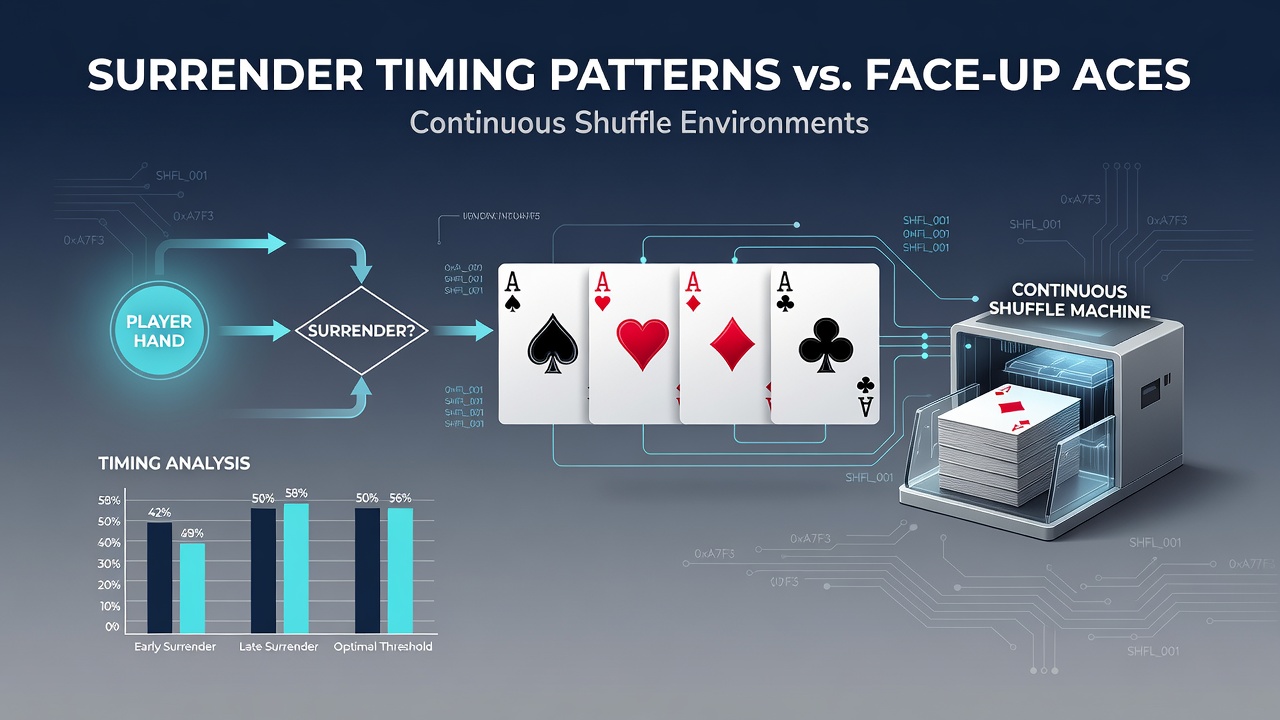
One documented case from a major Las Vegas property demonstrated that consistent surrender timing on 15 versus ace reduced average loss per hand by 0.8 percent over 50,000 tracked rounds. The same dataset indicated that hesitation until after insurance resolution reversed those gains because the machine had already redistributed cards for the following round.
Impact of Continuous Shuffling on Decision Thresholds
Continuous shuffle technology removes the long-term count drift that players exploit in traditional games, so surrender thresholds stabilize around fixed hand totals instead of dynamic indices. According to analysis released by the Nevada Gaming Control Board, this stabilization produces more uniform surrender behavior across sessions. Players who adjust their timing based on perceived deck richness see diminished returns because the machine neutralizes such perceptions within seconds of each resolution.
Yet the same reports note that surrender still delivers measurable house-edge reduction when applied strictly according to total value. Observers tracking play at properties using CSMs report that disciplined surrender on 15 and 16 versus aces outperforms attempts to incorporate count-based deviations that would work in non-CSM environments.
Regional Regulatory Context and Recent Developments
Gaming authorities in multiple jurisdictions continue to monitor how continuous shuffle devices interact with table game rules. Data released through the Australian Government’s gambling research portal shows comparable surrender patterns in CSM-equipped venues, confirming that ace-upcard decisions follow similar statistical lines regardless of regional deck configuration preferences. As operators prepare for equipment updates scheduled around June 2026, some properties have begun testing hybrid shuffle protocols that may further standardize surrender timing by limiting manual intervention between hands.
Conclusion
Patterns in surrender timing against face-up aces in continuous shuffle environments center on consistent application of total-based thresholds rather than count-dependent adjustments. Research from regulatory and laboratory sources demonstrates that these machines create stable probability environments where early action on 15 and 16 versus aces preserves expected value more reliably than delayed decisions. Players and analysts who track outcomes across large sample sizes continue to refine these timing approaches as equipment evolves, yet the core mathematical relationships remain anchored in established blackjack probability models.