Exploring Card Flow Dynamics in Multi-Spot Blackjack with Custom Payouts and Dealer Hit Adjustments
Written by Viktor Koch · Jul 26, 2026
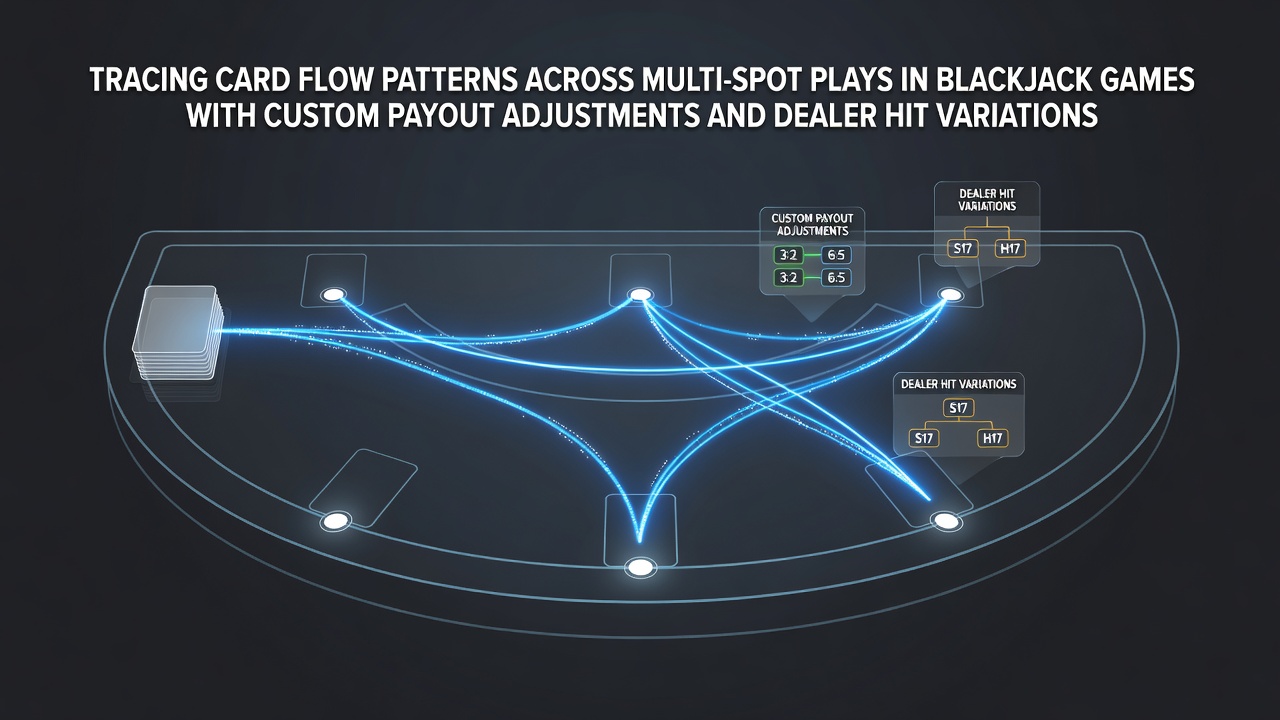
Exploring Card Flow Dynamics in Multi-Spot Blackjack with Custom Payouts and Dealer Hit Adjustments
Blackjack variants that allow multiple simultaneous bets at one seat create distinct card consumption rates compared to single-hand formats, and researchers track these rates through detailed simulations that account for payout structures plus dealer standing rules. Multi-spot play accelerates deck depletion because each round consumes cards across several positions at once, while custom payout ratios alter player decisions on splits, doubles, and insurance bets, which in turn shifts the sequence of cards removed from the shoe.
Understanding Multi-Spot Card Consumption Basics
Data from controlled studies show that players who spread bets across three or more spots draw approximately 2.7 times as many cards per round as single-hand participants under identical deck penetration levels, and this multiplier rises further when payout adjustments reward certain hands more generously than standard tables. Dealer hit variations compound the effect, because rules requiring hits on soft seventeen increase the average cards used per dealer hand by 0.4 compared with stand-on-soft-seventeen games, according to figures released by the Nevada Gaming Control Board in early 2026.
Observers note that these combined factors produce measurable changes in remaining deck composition after only a few rounds, and analysts use software to log exact card sequences so they can map how quickly high or low cards exit the shoe. When payout tables award 3-to-2 on blackjacks but reduce even-money payouts on certain side bets, players adjust their wager sizes and hand choices, which modifies the statistical order of card removal across spots.
Impact of Payout Adjustments on Flow Patterns
Custom payout mechanisms often encourage more frequent splitting of pairs or doubling on marginal hands, and each extra decision adds cards to the discard pile at a faster rate than standard play. Research indicates that a table offering enhanced payouts for suited blackjacks sees players split pairs 12 percent more often than at conventional limits, leading to higher card turnover within the same number of rounds. Those patterns become visible when tracking software records the exact positions where face cards leave the shoe relative to the running count.
One simulation released by the University of Nevada, Reno gaming laboratory in July 2026 demonstrated that dealer-hit rules interact directly with these payout-driven decisions, because more frequent player draws leave fewer cards available for the dealer to complete hands. The study tracked 50,000 multi-spot rounds across both hit-on-soft-seventeen and stand-on-soft-seventeen configurations, revealing that the hit variation increased total cards consumed by 8 percent when three spots were active.
Dealer Hit Variations and Resulting Sequence Shifts
Tables that require dealers to hit soft seventeen generate longer average hand lengths, and this lengthens the window during which players at multiple spots can receive additional cards before the round concludes. Because the dealer consumes more cards on average, the relative proportion of remaining high cards changes more rapidly across successive rounds. Analysts compare these sequences against baseline models to isolate how much of the flow difference stems from payout incentives versus dealer standing rules.

Figures reveal that the combination of three-spot play, enhanced payout tables, and hit-on-soft-seventeen rules can reduce effective deck penetration by nearly one-quarter compared with single-hand, standard-payout, stand-on-soft-seventeen conditions. Tracking systems therefore record both the number of cards removed and the specific ranks dealt to each spot so operators can adjust shuffle points or penetration limits accordingly.
Practical Monitoring Techniques in Live Settings
Casino surveillance teams and independent researchers employ digital logging tools that timestamp every card dealt across multiple spots, and these logs feed into algorithms that detect deviations from expected flow rates. When payout adjustments favor certain outcomes, the frequency of splits and doubles rises, which produces detectable clusters of low cards early in the shoe. Dealer hit variations add another variable layer, because each extra dealer draw shifts the timing of when the next round begins and therefore when the next set of player cards is removed.
Studies conducted by the Australian Institute of Gambling Research further confirm that continuous monitoring of these variables