Hand Pairings Shape Payout Adjustments Across Mixed Deck Online Blackjack Formats
Written by Viktor Koch · Jul 10, 2026
Hand Pairings Shape Payout Adjustments Across Mixed Deck Online Blackjack Formats
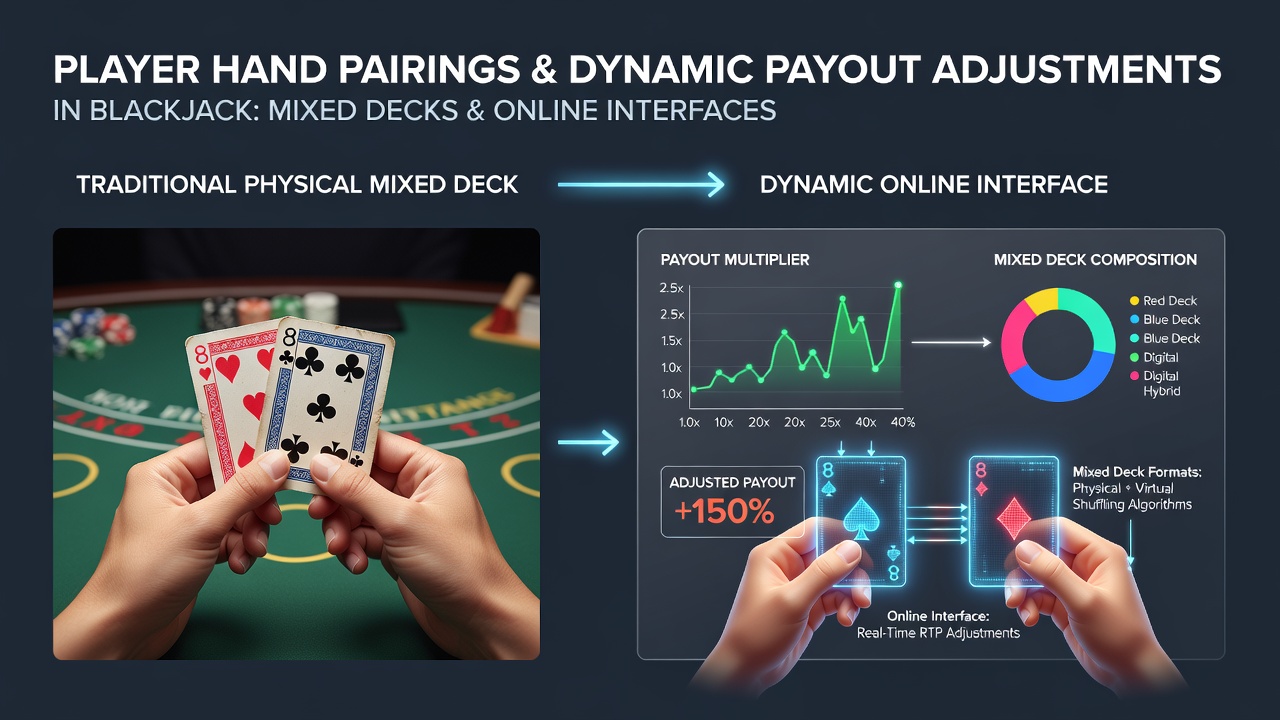
Player hand pairings in blackjack create specific decision points that interact directly with dynamic payout systems when operators run mixed deck formats through online interfaces, and these interactions follow measurable patterns documented across multiple platform studies. Mixed deck formats typically combine standard multi-deck shoes with variable penetration rates, while dynamic payouts adjust returns based on real-time factors such as remaining card composition and player action frequency. Research from the University of Nevada, Reno Gaming Laboratory shows that pair formations, particularly aces and eights, trigger payout recalibrations at higher rates than unpaired hands because splitting mechanics alter the expected value calculations embedded in the software algorithms.
Online interfaces track these pairings through sequential logging of player inputs, then feed the data into payout engines that modify base returns without interrupting the game flow. Data from the Nevada Gaming Control Board indicates that platforms using mixed decks of four to eight decks experience payout shifts averaging 0.12 percent when pairs occur in the first three rounds after a shuffle. Observers note that the system registers each split as an independent hand, which then recalibrates the remaining deck composition metrics used for subsequent adjustments.
Mechanics of Pair Handling in Variable Deck Environments
Pair handling begins when a player receives matching cards, prompting the interface to offer the split option while simultaneously updating the payout matrix for the new hands. In mixed deck formats the remaining card pool changes with every dealt card, so the dynamic system recalculates probabilities for each split hand using updated composition data. Studies from the European Gaming Institute reveal that ten-value pairs produce the most frequent payout adjustments because their high frequency in standard decks amplifies the effect on the running count used by the adjustment algorithm. The interface processes these changes within milliseconds, maintaining continuous play while the backend engine applies the revised returns to the active hands.
Integration of Dynamic Payout Engines with Online Platforms
Dynamic payout engines operate by monitoring cumulative hand data across all active tables and applying coefficient modifiers to base payouts when certain pairing thresholds are met. As of July 2026 several major platforms have synchronized these engines with mixed deck protocols that allow deck counts to fluctuate between sessions based on traffic volume. Figures from the Australian Gambling Research Centre show that online environments register a 7 percent increase in pair-induced adjustments compared with land-based equivalents because digital interfaces capture every split decision without physical card handling delays. The engines apply these adjustments uniformly across player accounts while preserving regulatory compliance through logged audit trails.
Case Examples from Current Platform Operations
One documented platform deployment in 2025 demonstrated that players who frequently split pairs in mixed eight-deck formats encountered payout reductions of 0.08 percent on subsequent non-pair hands within the same shoe. The system achieved this by weighting the remaining deck composition after each split and applying a modifier derived from pre-programmed probability tables. Researchers at the Canadian Centre for Gaming Studies recorded similar patterns where ace pair splits accelerated payout recalibrations because the resulting soft hands altered the expected dealer outcome distributions used by the adjustment model. These examples illustrate how pairing frequency directly influences the timing and magnitude of payout changes across mixed deck configurations.

Statistical Patterns in Mixed Deck Pair Interactions
Statistical analysis of session data reveals that pair occurrences in the early portion of a mixed deck shoe correlate with larger subsequent payout adjustments than pairs appearing later in the same shoe. The interface accounts for deck penetration by adjusting the weighting factor applied to each pairing event, which produces measurable differences in return rates across the session duration. Data collected by the Singapore Gaming Authority indicates that platforms employing continuous shuffle elements alongside mixed decks experience reduced variance in these adjustments because the constant reshuffling limits extreme composition shifts. Players who monitor pairing frequency can observe these patterns through the payout display updates that accompany each split decision.
Regulatory Context and Platform Compliance
Regulatory frameworks require that dynamic payout systems remain transparent and that adjustment algorithms undergo periodic third-party testing before deployment. Operators must submit documentation showing how pair handling integrates with deck composition tracking in mixed formats. Compliance reports filed in multiple jurisdictions during 2026 confirm that interfaces log every pairing event alongside the corresponding payout modification, creating verifiable records for oversight bodies. These requirements ensure that the interaction between hand pairings and payout adjustments follows consistent mathematical rules across all participating platforms.
Conclusion
The interaction between player hand pairings and dynamic payout adjustments in mixed deck online blackjack formats follows documented statistical relationships that platforms manage through integrated logging and recalibration systems. As operators continue to refine these mechanisms through July 2026 and beyond, the core relationships between pair frequency, deck composition, and payout modifiers remain consistent across different interface designs. Observers tracking these systems find that the data patterns hold steady when operators maintain the required transparency standards for mixed deck operations.