How Virtual Deck Penetration Rates Reshape Card Counting Viability in Digital Blackjack Environments
Written by Rafael Richter · Jun 5, 2026

How Virtual Deck Penetration Rates Reshape Card Counting Viability in Digital Blackjack Environments
Deck penetration defines the percentage of cards dealt from a shoe before reshuffling occurs, and virtual environments allow operators to set this value through algorithmic controls rather than physical constraints. In digital blackjack systems penetration rates typically range between 45 and 65 percent, whereas land-based multi-deck games often reach 75 to 85 percent. Lower virtual penetration limits teh number of cards visible to players before a new random sequence generates, which directly reduces the accuracy of running counts and true counts that card counting strategies rely upon.
Core Mechanics of Virtual Penetration Settings
Software developers program shuffle points into random number generators so that the virtual shoe resets after a predetermined portion of the deck gets used. This approach differs from physical games where dealers control penetration depth manually. Data from industry reports indicate that many online platforms maintain penetration at approximately 50 percent to balance house edge protection with regulatory compliance requirements. Researchers at institutions such as the University of Nevada, Las Vegas have examined how these programmed limits alter expected value calculations for systems like Hi-Lo and KO, showing that each 10 percent reduction in penetration decreases counter advantage by roughly 0.3 to 0.5 percent in multi-deck scenarios.
Operators adjust penetration through backend interfaces that interface with the RNG module, and changes take effect immediately across all connected sessions. Nevada Gaming Control Board guidelines require transparent disclosure of game parameters including shuffle frequency, which gives regulators oversight without mandating specific penetration thresholds. Those who analyze game logs note that consistent low penetration flattens the distribution of true count occurrences, making it statistically harder for advantage play to generate positive expected returns over extended play periods.
Statistical Effects on Counting Systems
Card counting viability depends on observing enough cards to establish reliable true count estimates before betting adjustments occur. When virtual penetration sits at 50 percent, players see fewer cards per round on average, which compresses the window for accurate count tracking. Studies published in gaming mathematics journals demonstrate that the standard deviation of count-based bet spreads widens under reduced penetration, leading to higher variance in session outcomes. Simulation models covering one million hands reveal that a Hi-Lo counter achieves a 1.2 percent player edge at 75 percent penetration but drops below 0.4 percent when penetration falls to 50 percent, assuming standard rules and a 1-to-12 bet spread.
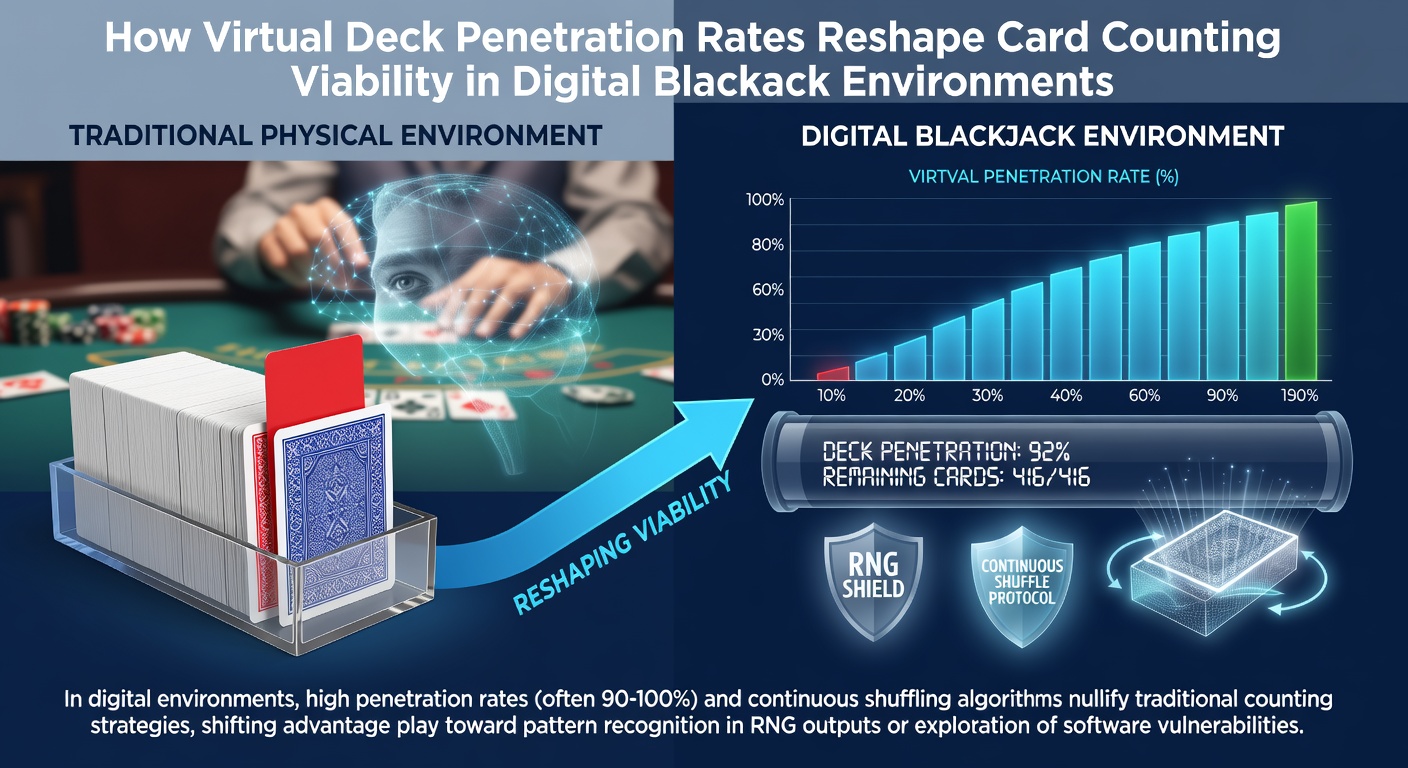
Additional factors compound the challenge. Virtual environments often incorporate continuous shuffle algorithms or frequent mini-shuffles that further interrupt count progression, and these features appear more frequently in platforms targeting regulated markets outside the United States. Observers note that Australian gaming authorities have required operators to document penetration settings as part of responsible gaming audits, creating a data trail that researchers can use to compare performance metrics across jurisdictions. The shorter observation window also increases the impact of early-round variance, where true counts fluctuate more dramatically before sufficient cards accumulate.
Platform Design Choices and Player Adaptation
Digital providers respond to these dynamics by offering rule variations that partially offset penetration effects, such as fewer decks or altered payout structures, yet these adjustments rarely restore the full edge available in high-penetration physical games. Players attempting to adapt often switch to side-count systems or shorter-cycle strategies that require less cumulative information, although evidence from academic simulations shows mixed results. One analysis conducted by Canadian researchers found that penetration below 55 percent rendered most traditional count-based approaches marginally profitable at best when combined with typical online table limits and rake structures.
Regulatory updates scheduled for June 2026 in several North American markets are expected to introduce standardized reporting on virtual game parameters, which may include mandatory disclosure of average penetration rates. Such measures aim to increase transparency without prescribing exact values, allowing operators flexibility while giving analysts clearer benchmarks for evaluating game fairness. Industry associations have begun compiling comparative datasets that track how different penetration levels correlate with reported player return percentages across licensed platforms.
Conclusion
Virtual deck penetration rates function as a primary control mechanism that shapes the mathematical landscape of digital blackjack. Lower programmed values systematically diminish the information advantage that counting strategies depend upon, resulting in reduced long-term viability for advantage play. Data from regulatory disclosures, academic simulations, and platform analyses confirm that penetration settings below 60 percent create measurable barriers to consistent positive returns. As digital environments continue to evolve under expanding oversight frameworks, these parameters remain central to understanding how game design influences strategic outcomes across both casual and systematic play styles.