Strategic Split Decisions Under Dealer Hit Variations in Digital and Physical Blackjack Environments
Written by Mia Brooks · Aug 21, 2026
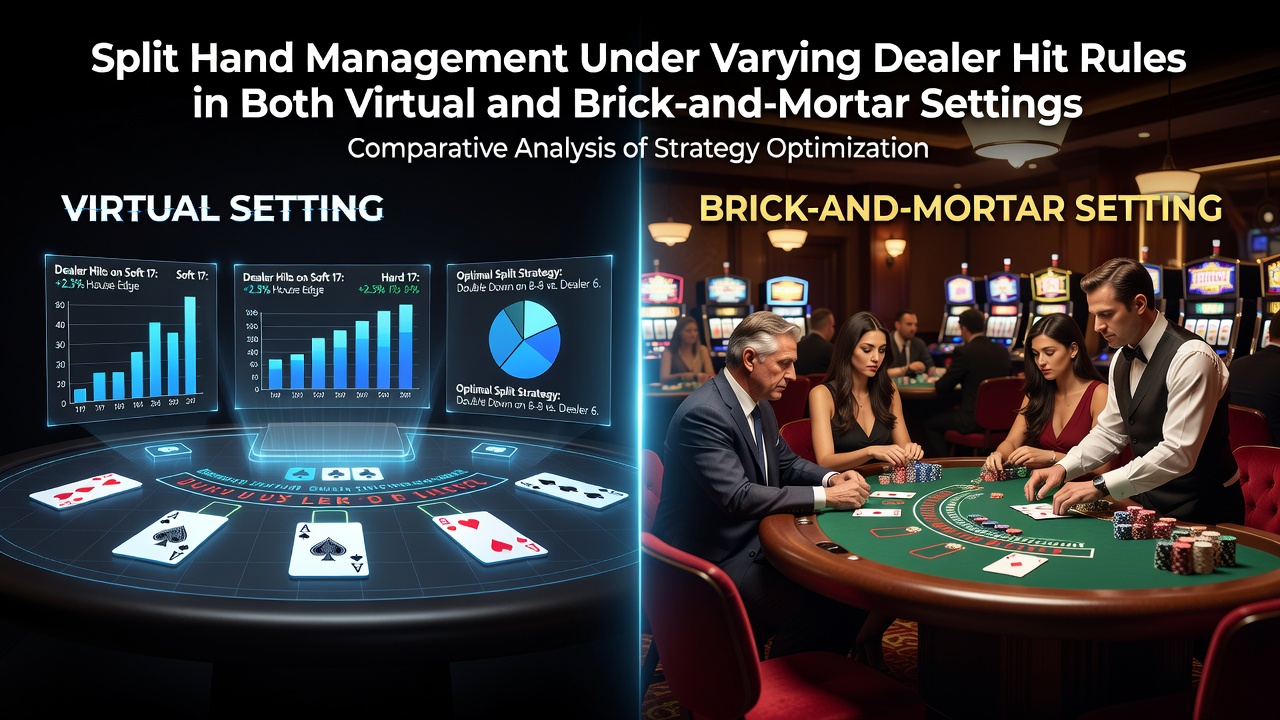
Strategic Split Decisions Under Dealer Hit Variations in Digital and Physical Blackjack Environments
Blackjack players encounter different decision matrices when managing split hands depending on whether the dealer hits or stands on soft seventeen, and these rules create measurable shifts in optimal play across virtual platforms and brick-and-mortar venues. Data from multiple gaming jurisdictions shows that dealer hit rules alter the expected value calculations for pairs such as aces, eights, and nines, particularly when players face dealer upcards of two through six.
Core Mechanics of Split Hand Evaluation
Players receive two cards of equal rank and elect to split them into separate hands, each requiring an additional wager equal to the original bet. Researchers at gaming analysis centers have documented that the subsequent strategy for each new hand depends directly on the dealer hit rule because it changes the probability distribution of the dealer's final total. In games where the dealer must hit soft seventeen, the house gains a small additional edge on certain player splits, while games requiring the dealer to stand on soft seventeen produce slightly different thresholds for splitting borderline pairs.
Those who track large sample sizes across thousands of hands note that splitting pairs of twos and threes against a dealer two becomes more favorable under stand-on-soft-seventeen rules because the dealer busts more frequently when holding a weak upcard. Conversely, when the dealer hits soft seventeen, the same split decision carries a marginally lower return because the dealer completes more hands between seventeen and twenty-one.
Differences Between Virtual Platforms and Physical Casinos
Virtual blackjack environments often implement automated rule enforcement that applies the chosen hit or stand parameter uniformly across every round, whereas physical tables may incorporate slight procedural variations based on house policy or regulatory oversight. Studies conducted by independent testing laboratories indicate that online systems display the exact dealer hit rule in the game information panel, allowing players to reference pre-programmed strategy charts without ambiguity. In contrast, land-based dealers follow printed procedures posted at each table, and observers have recorded occasional delays when new staff members confirm whether soft seventeen requires an additional card.

Continuous shuffle machines common in many physical casinos reduce the impact of deck composition changes after splits, while virtual random number generators reset probabilities for each hand independently. Figures released by the Nevada Gaming Control Board demonstrate that split-hand frequency remains statistically consistent across both formats when the dealer hit rule stays constant, yet the timing of card delivery differs: physical tables require manual dealing after each split, whereas digital interfaces resolve multiple hands in rapid succession.
Adjustments for Specific Pair Types
Pair of aces receives a split recommendation against nearly every dealer upcard under both hit and stand rules, yet the expected value gap widens slightly when the dealer hits soft seventeen because the dealer reaches higher totals more often. Pairs of eights follow a similar pattern, with splitting remaining the dominant choice against dealer upcards of two through nine regardless of the soft seventeen parameter. Research published by the University of Nevada, Reno gaming management program shows that pairs of nines warrant splitting against dealer six and seven more frequently in stand-on-soft-seventeen games, whereas the same pair against a dealer eight produces near-zero value difference between the two rule sets.
Players managing multiple simultaneous splits in virtual multi-hand formats encounter additional card consumption that does not occur at single-hand physical tables. Data collected from regulated European operators reveals that split frequency per round increases when platforms allow up to three concurrent hands, yet the core strategy thresholds for each individual split remain governed by the posted dealer hit rule.
Practical Implementation Across Venues
Brick-and-mortar establishments post the dealer hit rule on signage at each table, and dealers verbally confirm the rule during player inquiries. Virtual platforms embed the same information within the rules menu, and several operators provide interactive strategy calculators that toggle between hit and stand parameters. Analysts at the Australian Gambling Research Centre have compiled comparative tables showing that players who adjust split decisions according to the active dealer rule maintain closer alignment with theoretical returns than those who apply a single universal chart across all games.
Deck penetration rates in physical multi-deck shoes influence how often split opportunities arise late in the shoe, while virtual games typically shuffle after each round or at fixed intervals regardless of split activity. These mechanical differences affect the volume of split decisions encountered per hour but leave the mathematical correctness of each decision unchanged.
Conclusion
Split hand management requires reference to the specific dealer hit rule in force, whether the game operates on a digital interface or a physical felt table. Consistent application of the appropriate strategy adjustments for each pair type produces measurable alignment with expected value calculations derived from exhaustive combinatorial analysis. Regulatory documentation and laboratory testing continue to confirm that the same decision thresholds apply across both environments when the dealer hit parameter remains identical.