The Ripple Effect of Small Mistakes on Blackjack Probabilities and Long-Term Results
Written by Clara Otto · May 15, 2026
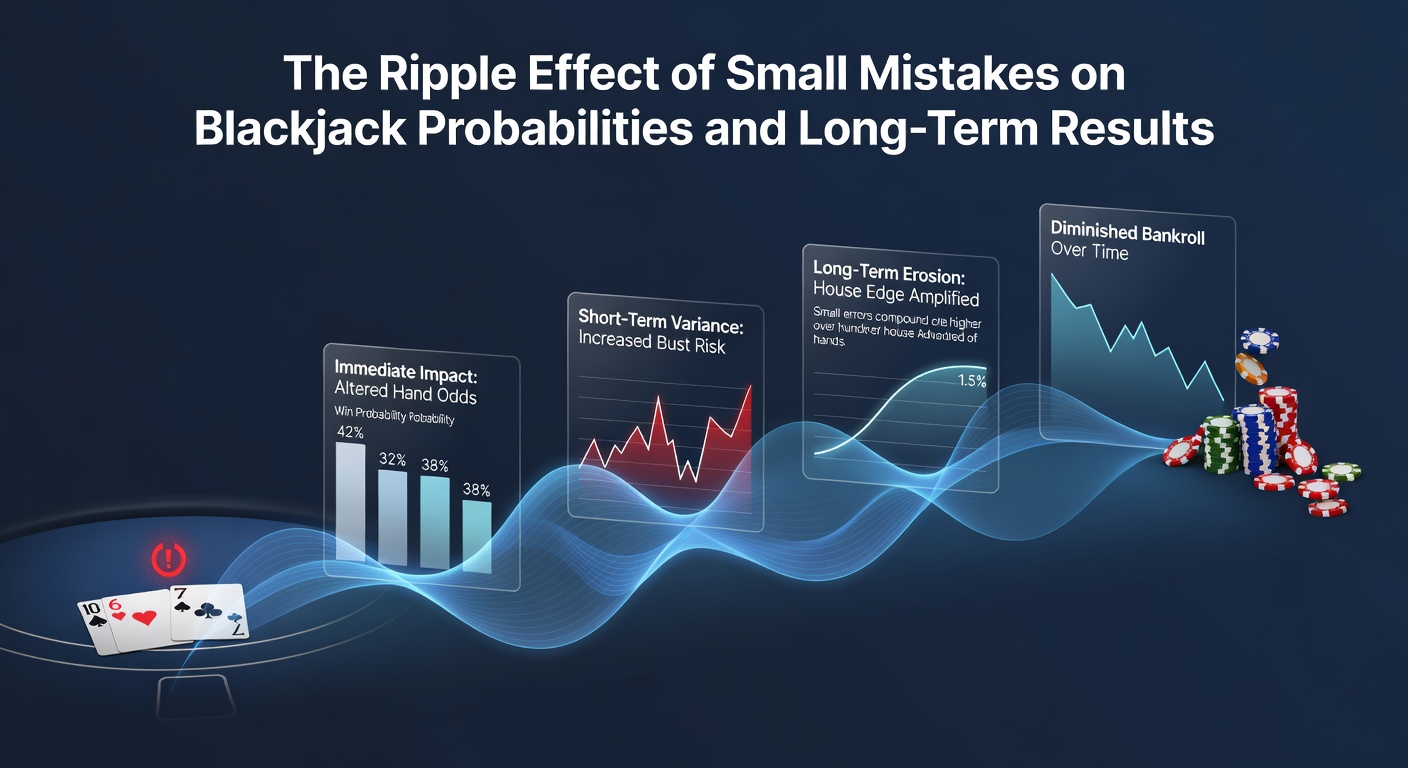
The Ripple Effect of Small Mistakes on Blackjack Probabilities and Long-Term Results
Blackjack probabilities hinge on precise decisions at every turn, and even minor deviations from optimal play create measurable shifts in expected outcomes that accumulate across extended sessions. Researchers have documented how these small errors alter the house edge, which sits near 0.5 percent when players follow basic strategy perfectly yet rises noticeably with repeated mistakes. Observers note that the game rewards consistency because each hand contributes to an overall mathematical expectation that becomes visible only after thousands of decisions.
Core Mechanics Behind Blackjack Odds
Basic strategy charts outline the statistically sound move for every possible player hand against each dealer upcard, and adherence to those guidelines keeps the casino advantage at its lowest point according to multiple simulation studies. Players who deviate by hitting when they should stand, or by splitting pairs incorrectly, immediately change the probability distribution for that hand. Data from industry simulations shows that a single incorrect choice on a hand like sixteen against a dealer ten increases the house edge for that round by roughly two percent compared to the optimal play.
Those who've studied the mathematics understand that blackjack is a game of dependent events where the composition of the remaining deck influences future probabilities. A mistake early in a shoe does not exist in isolation, it leaves the player facing altered odds on subsequent hands because the deck no longer matches the expected distribution. Experts have observed that this dependency amplifies the cost of errors when players remain at the table for long stretches without reshuffling.
How Individual Errors Compound Over Time
One study revealed that a player who makes an average of one mistake every twenty hands experiences an effective house edge climb from 0.5 percent to nearly 1.8 percent over the course of ten thousand hands. The additional edge does not appear dramatically in short sessions, yet it produces a consistent negative expectation that erodes bankrolls steadily. Researchers discovered through Monte Carlo modeling that the gap between perfect play and frequent minor errors widens dramatically as the number of hands increases, turning what feels like random variance into a predictable drain.
Consider a typical table where a player occasionally stands on fifteen against a dealer six instead of hitting. That single choice carries an expected value loss of about 0.4 units per occurrence. When repeated across hundreds of similar situations the cumulative effect becomes equivalent to adding several extra hands of house advantage each hour. Those who've analyzed session data find that such patterns explain why some players report steady losses despite believing they play close to correctly.
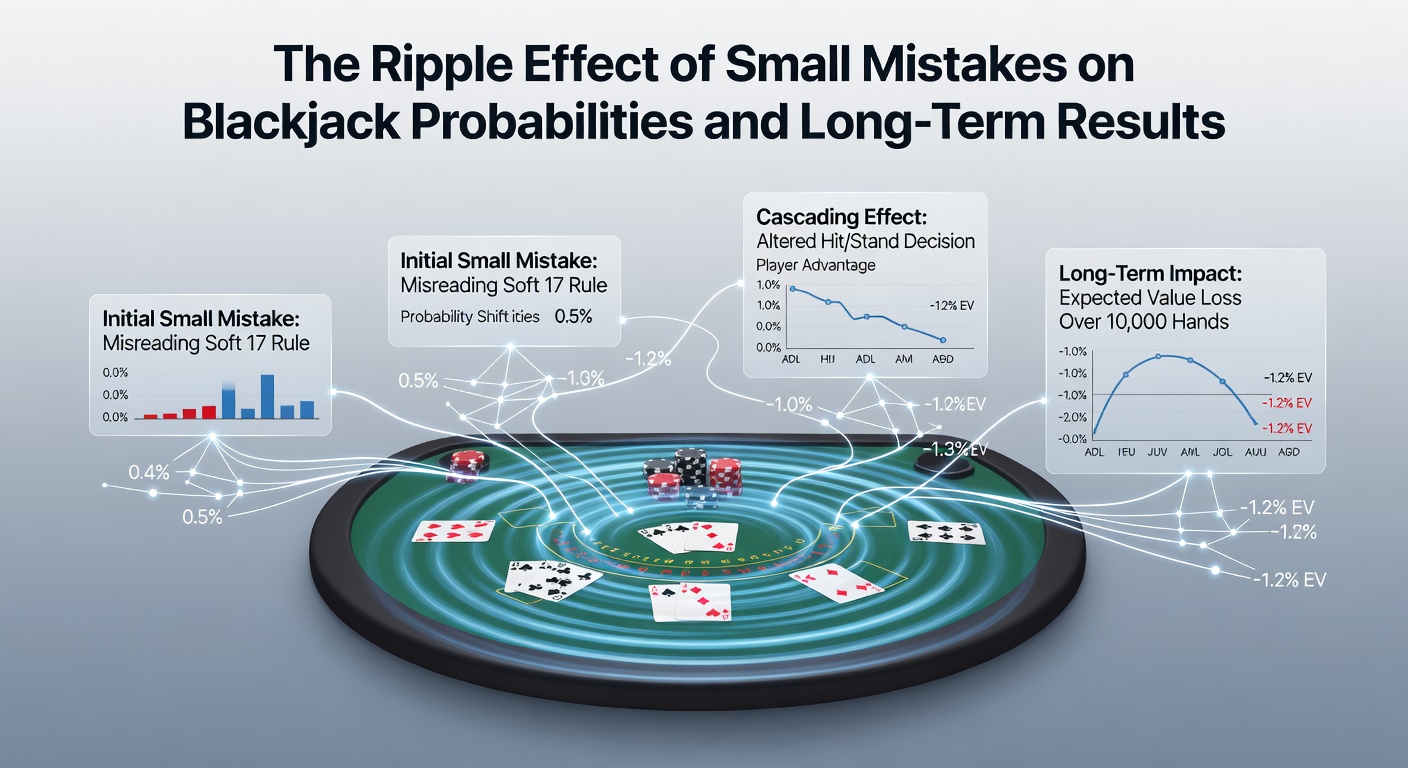
Real-World Patterns and Variance Factors
Observers note that variance masks the impact of mistakes during any single evening, which is why many players continue suboptimal habits without immediate feedback. A night of strong cards can produce wins even when the underlying strategy contains flaws, while a poor run highlights every error. According to figures from the Nevada Gaming Control Board reports on table game performance, the aggregate results across thousands of players consistently show that those who apply basic strategy more accurately maintain their bankrolls longer than those who do not.
Another layer appears when players adjust bets based on perceived momentum rather than true count, which compounds the cost of earlier strategic mistakes. Data indicates that combining even small play errors with aggressive betting spreads increases the speed at which the house edge asserts itself. Academic research from institutions tracking casino outcomes across multiple jurisdictions confirms that disciplined adherence to strategy reduces the rate of bankroll depletion regardless of short-term swings.
People often find that reviewing hand histories after sessions reveals clusters of repeated mistakes on specific hand types, such as soft totals or pair splits. Correcting just those recurring choices produces a measurable improvement in long-term expectation without requiring perfect recall of every chart entry. The reality is that the most common errors involve high-frequency situations like hitting or standing on stiff hands, and addressing them yields the largest reduction in added house edge.
Conclusion
Small deviations from optimal blackjack decisions create ripple effects that alter probabilities and reshape long-term results through straightforward mathematical accumulation. Players who examine their own patterns against established strategy guidelines can identify where those ripples begin and reduce their frequency over time. Evidence from extensive simulations and regulatory performance data demonstrates that consistency across many hands remains the primary factor separating stable play from gradual erosion of capital.